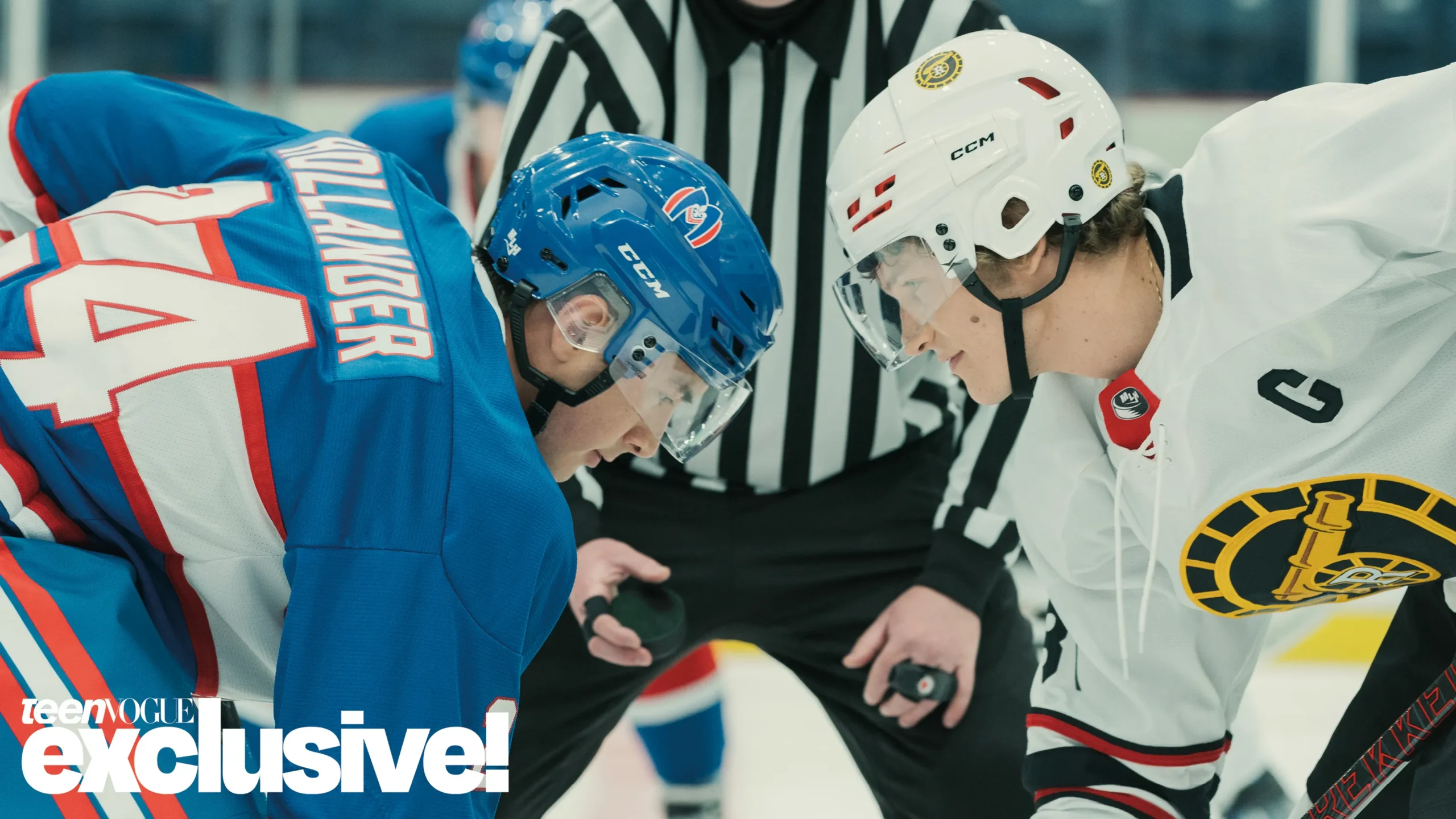
I’m sure we’ve all watched the highly discussed queer hockey romance distributed by HBO, Heated Rivalry. It’s become quite the internet sensation for a few reasons, with one of the most obvious being that you get to watch beautiful men get steamy on screen. That’s part of the lure, for sure. But let’s go deeper and discuss why it’s this particular queer romance that’s drawing people in.
The Cast:
Heated Rivalry was an unexpected delight for most fans, introducing us to Connor Storrie as Ilya Rozanov, a Russian ice hockey player entering the NHL, and Hudson Williams as Shane Hollander, a half Japanese, half white Canadian with a hockey IQ that makes him one of the best players on the ice.
Connor, despite being Texas born, brings Ilya Rozanov to life with a sexy Russian accent and a gentle dominance that allows him to command the screen whenever he’s on it.
Hudson matches that energy as Shane Hollander. Not only is his hockey IQ portrayed as unrivaled, but he also does an amazing job of bringing out one of Shane’s most important “qualities”, his autism. Through subtle acting, Hudson draws a sense of empathy from the audience towards a character who is learning to unlearn internalized homophobia and become okay with being queer.
A few supporting characters also deserve to be highlighted, including Scott Hunter, Rose Landry, Svetlana Vetrova, and Hayden Pike. These characters are important allies in the book, but in the show they were adapted to be a bit more dimensional.
The most important part about the cast is that they are new faces(finally!). I’ve seen dozens of TikTok videos, Instagram reels, and posts on Tumblr (admitting this makes me feel old) about how people are sick and tired of seeing the same faces over and over. I have to agree with wanting fresh faces. The nepo baby epidemic is driving me nuts. It’s not just the fresh faces that hit the mark, but the fact that those faces can truly act. That’s what made it such a compelling production that felt honest and had a real sense of vulnerability. We saw hard work and actors who were hungry for experience, and it truly paid off.
Sexuality + Compulsory Heteronormativity
One of the most fascinating experiences for me has been realizing how compulsory heteronormativity impacts society’s ability to understand the subtext of queer relationships. I was in Japan with a friend, a very dear friend (who is wonderful) , and we had a conversation about what is categorized as romance and the ways queerness impacts our ability to build relationships.
For my friend, she didn’t find the show romantic. She prefers grand gestures and absolutely loves the angst in media like K dramas. I, however, found Heated Rivalry to be very romantic, like when Rozanov made sure to have ginger ale, which made me swoon, and when they played in the lake, which felt so heartwarming.
Despite what I viewed as cute and vulnerable moments between the pair, along with their many phone calls throughout a decade, my friend just didn’t feel like it touched her heart. I tried to understand why we viewed the show so differently, and after hearing her thoughts about how love cannot be built off a few phone calls and escapades, I realized that the core of her disconnect lived in how queer relationships rely on a silent intimacy rooted in shared identity and trust that is not always immediately obvious to others.
This conversation also made me reflect on how compulsory heteronormativity has created an invisible barrier for me in pursuing romantic relationships. I am always too concerned about what I am supposed to do instead of what actually feels right.
Hockey Thinks White Is Right
Hockey is so fun to watch, and hockey plus romance is a fire combination, in fictional universes at least. The truth is, and I’m saying this as an avid hockey watcher, hockey is so damn white. And when it is that white, whiteness permeates the entire space.
I want to be clear. It is not just that hockey has a lot of white players. It is that whiteness as a system relies on maintaining power and status, often at the expense of others. Even beyond the players, it is the system itself that perpetuates harmful dynamics and politics, which is a whole other conversation.
The show starts to tell the story of how hockey culture is extremely straight, white, and everything phobic. This is where I think the story falls flat. For a plot that relies on a forbidden relationship to move forward, it does not make it clear enough what Rozanov and Hollander are actually up against. I mean, come on, a speech from Scott in the last episode and a few montages are supposed to give the audience full understanding?
I get it. It is not an easy task. But the show struggles with conveying just how intense the rivalry and pressure are within toxic hockey culture.
Nonetheless, I loved Heated Rivalry. It felt fresh, intimate, and the soundtrack was fire! What more do you need to be entertained? The show essentially had two nickels and a dream, and considering what they were working with, I would call it a job well done.
With season two slated to air sometime in 2027, and the internet already in withdrawal after a strong and emotional finale, I’m excited to see Rozanov and Hollander reprise their roles. I’m hoping for deeper character development and a stronger narrative around hockey culture, while still holding onto what made the show work in the first place, that gentle, yearning queer romance with a happy ending that reminds Hollywood why stories like this matter.
Stay whimsy!
- Bri 🙂